
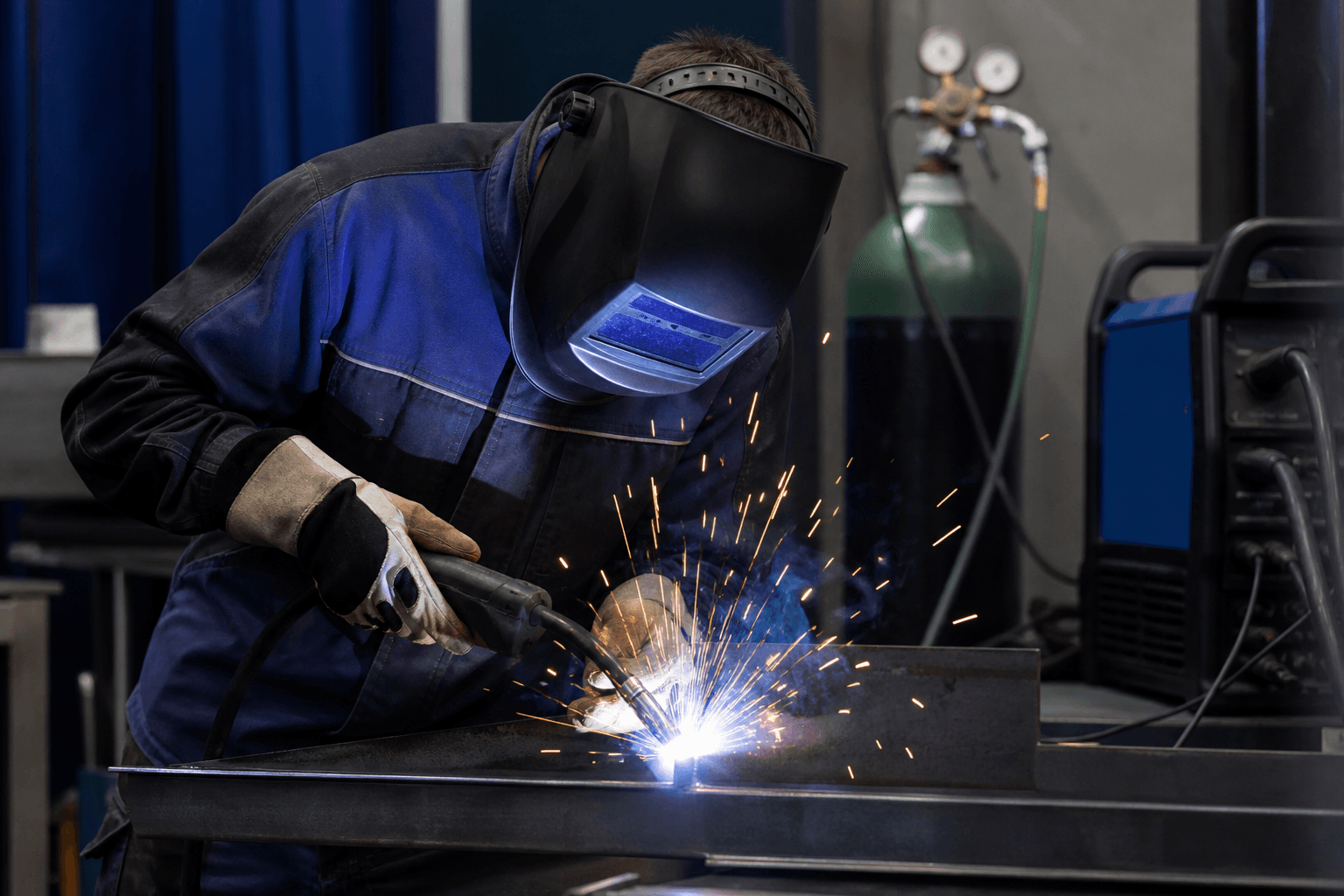
Complete MIG CO2 Welding Guide: What to Know Before the Course
Welding Magazine
MIG welding with CO2 gas is one of the most in-demand processes in industry. Here you will understand equipment, safety, technique, and what it really takes to enter the trade with confidence.
IG welding with CO2 , also known as GMAW, is one of the most sought-after welding processes in Israeli industry and worldwide. A continuous wire electrode is fed through a to the joint while a shielding gas, usually carbon dioxide or a CO2-rich mixture, protects the from atmospheric oxidation. The result is a high work rate, solid on carbon steel, and a process that is relatively approachable to learn compared with more precise methods such as TIG welding. Employers in factories, fabrication shops, construction, and industrial maintenance look for welders who already control MIG, because the mix of speed, cost, and output fits continuous production across full shifts. The wire reduces frequent coated-electrode changes, and relatively affordable gas supports uninterrupted work, so a clear grasp of the process is a strong entry point into the job market and into any professional aimed at employment. A capable MIG welder does not only strike an arc. They read the bead in real time and adjust parameters to material thickness, joint type, and shop conditions.
Before you strike the first arc, treat the equipment as one system rather than a pile of separate parts. The MIG machine supplies controlled current and , the wire feeder sets travel of the electrode, the gun delivers current and gas to the work point, and the cylinder with its govern flow. Every component affects bead quality: wire speed that is too high creates and instability, unsuitable voltage produces or burn-through, and weak gas flow leaves in the weld. Wire diameter is a daily decision. Thinner wire suits finer work and lower currents, while thicker wire supports high fill rates on heavier joints. Gas quality and the regulator also affect porosity directly, so basic gun care, cleaning, feed checks, and timely contact-tip replacement are part of the trade, not optional extras. In a MIG welding course, students learn to check the system before every shift: cables, connectors, gas , regulator, and feed mechanism, because a small equipment fault becomes a large .
Correct parameter setting is the heart of MIG CO2 work. Voltage and current set arc intensity and penetration depth, sets how much metal enters the pool per unit of time, and gas flow sets how well the pool is protected. Stick-out, the distance from the to the work, affects and . A useful rule for beginners is to start from manufacturer tables or the machine guide, then make small adjustments based on bead appearance. Excessive spatter often points to feed that is too high or voltage that is too low. A tall, narrow bead can signal voltage that is too high or travel that is too slow. Porosity often points to weak gas, dirty , or drafts in the shop. A professional welder does not hunt for one magic number. They build a stable working range that still holds when access to the joint is awkward. Deliberate practice changing one parameter at a time teaches faster than random trial and error.
in MIG CO2 is not an add-on. It is a baseline condition for every shift. An auto-darkening with a shade suited to the process and current protects the eyes from UV and IR radiation. Alongside it, leather gloves, welding sleeves or a flame-resistant apron, safety footwear, and cotton or FR clothing are mandatory. Synthetic fabrics that melt on contact with sparks have no place in the booth, and the shop must be well ventilated or fitted with , because carries metal oxides and gases that are harmful under prolonged exposure. A critical point with CO2 is work in enclosed areas: carbon dioxide is heavier than air and can collect at low levels and displace oxygen. Work inside tanks, pits, closed plant rooms, or other confined spaces needs , and sometimes gas detection and formal entry procedures. Never weld alone in a without supervision and emergency equipment. Before every shift, check cables, connectors, the gun, the gas hose, and the regulator. Gas leaks, damaged insulation, or exposed conductors are direct risks for shock and fire.
MIG rests on gun angle, stick-out, , and whether you push or pull relative to the joint. On fillet joints welders often push so they can see the pool. On flat joints they sometimes pull for better control of . A good bead looks uniform, with adequate penetration, without holes, without excessive spatter, and without undercut along the toes. Learning to recognize defects such as porosity, , over-penetration or under-penetration, and turns execution into professional judgment, because you then correct machine settings with intent. Cleaning the base metal before the arc is part of technique as well. Paint, rust, or oil will ruin a bead even when hand movement is precise. MIG positions demand access planning, because you are not always upright at a table. You may work on a large structure, in a trench, or at an awkward angle. Sound practice teaches how to stabilize the body, support the hand, and keep wire distance consistent even when access is limited.
To understand the process in depth, learn the main metal transfer modes: , , and . Each mode suits different thicknesses and current-voltage ranges. Beginners usually master short-circuit first on thin to medium plate, then move to more aggressive settings for deeper penetration. Short-circuit gives a relatively clean bead and good control. Globular suits medium thicknesses. Spray allows deep penetration but demands experience managing spatter. Transfer mode also relates to gas type: pure CO2 usually produces a more aggressive arc, while blends soften the arc. In a professional course, students practice moving between modes and learn to connect arc appearance, welding sound, and bead look. That skill separates someone who can switch a machine on from someone who can produce a consistent bead across a full shift.
Visual quality control is inseparable from professional MIG welding. You learn to spot , lack of root penetration, undercut, heavy spatter, porosity, and cracks, then link each defect to a likely cause such as travel speed, angle, voltage, wire feed, material cleanliness, or stick-out. Lack of in corners and sharp angles is common when the weld sequence is poorly planned. Over-penetration can waste filler and create mechanical problems. A good welder knows when to stop and repair before continuing, because late repair costs more. Using welding screens to protect nearby workers is also part of professional responsibility, because the arc light is hazardous to people standing close by. Clearing oil, paint, and flammable materials from the work area, and keeping an extinguisher nearby, are habits you keep even under time pressure.
A short comparison helps when choosing a professional path. Stick electrode welding is more flexible in the field and cheaper in equipment cost, but slower and interrupted by frequent electrode changes. TIG welding is more precise and cleaner, especially on and aluminium, but slower and typically more demanding to learn. MIG welding sits in the middle: fast, productive, and suited to most carbon-steel fabrication, which is why employers often treat it as a first hire skill. Many welders learn MIG or stick first and add TIG later as a specialty. MIG CO2 is a strong gateway into the trade when you understand the equipment, control parameters, keep welding safety non-negotiable, and practice enough in real positions. Consistent practice across positions, together with parameter literacy and safety discipline, builds confidence faster than theory alone. If you want a structured path with booth practice, supervision, and preparation for , you can continue to the MIG CO2 course page and see what the track includes in practice.
Found a mistake in the article? Have an idea or suggestion? Want to publish with us?
Share this article
Related course
Welder's pocket glossary
Digital pocket glossary, a must for every welder
500 critical welding terms, now in the palm of your hand.

Welder's pocket glossary
Ready to get started?
Leave your details and our study advisor will get back to you with dates, costs, and admission requirements.
Leave details